
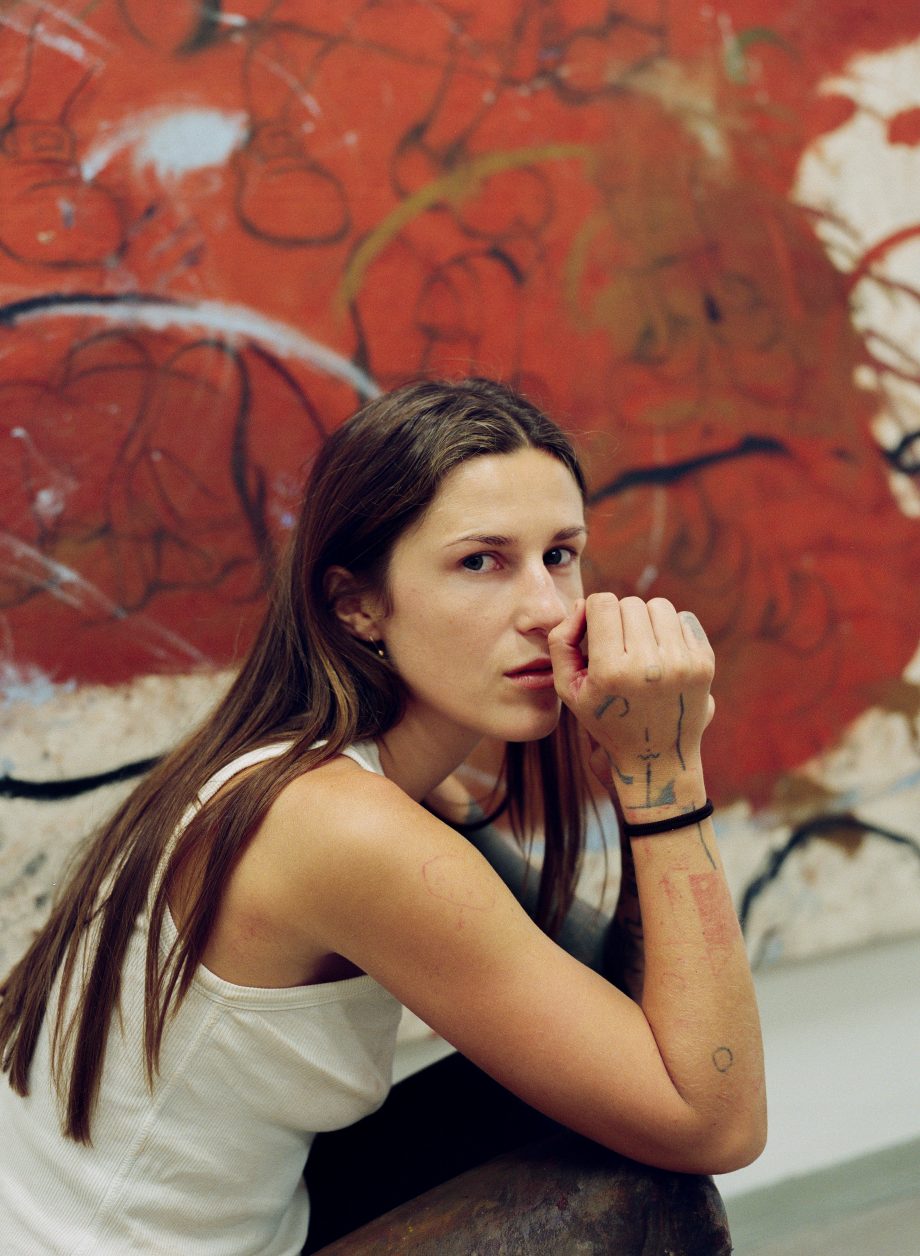
PAINTER. MORAVIA/PRAGA, CZECH REPUBLIC
ESTER PARASKOVÁ NAVIGATES THE SPACE BETWEEN SPONTANEITY AND DISCIPLINE, WHERE THE STUDIO FLOOR TURNS INTO CANVAS AND ACCIDENTAL MARKS BECOME ESSENTIAL TESTIMONY. HER HANDS DO NOT ILLUSTRATE, THEY DOCUMENT EFFORT. HER PAINTINGS ARE SEEN AND FELT THROUGH THE RETINA. ROUTINE DOES NOT STAGNATE, IT UNCOVERS. EFFORT DOES NOT DISAPPEAR, IT SETTLES. THE FABRIC RETAINS IMPRINTS, RESIDUES, THE SILENT EVIDENCE OF PHYSICAL PRESENCE. FAMILIAR. STARRING @ESTERPARASKOVA WWW.ESTERPARASKOVA.COM
PHOTOGRAPHY COURTESY ESTER PARASKOVÁ
“Could you define your work? Where are your latest paintings heading? Tell us a little about your style.“
I see my work as a constant negotiation between expressive gesture and disciplined, almost mechanical drawing. It is partly rooted in my own experience of manual labour, particularly from the time when I worked on a production line in a factory producing automotive parts. I try to transfer this mechanical, repetitive movement directly into the painting.
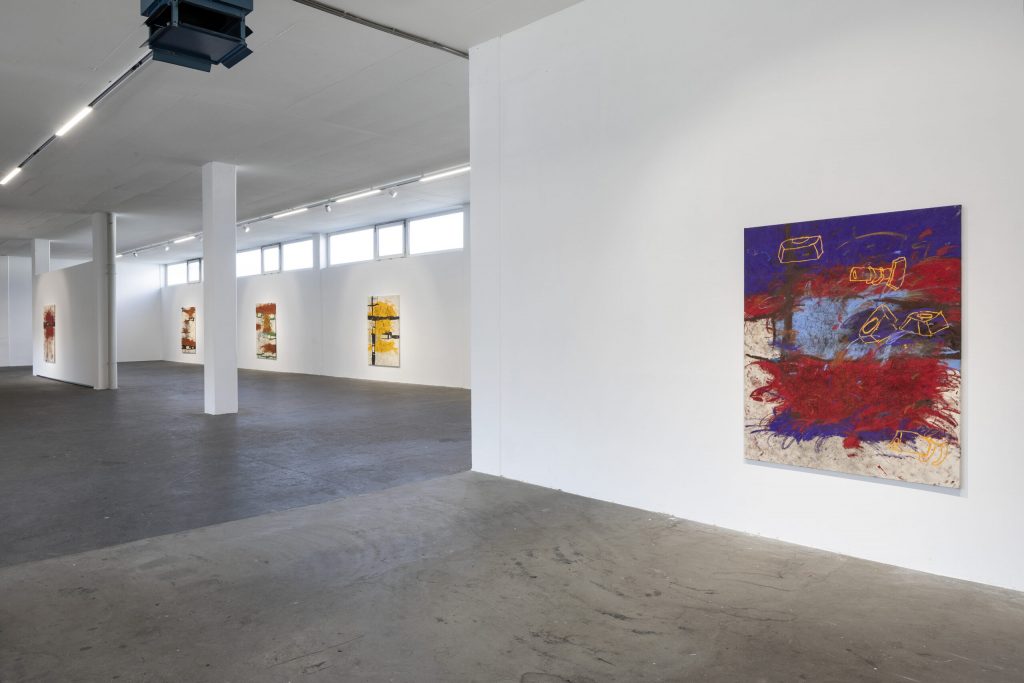
I mainly work with large-scale drawings on canvas, which evoke painting through their scale and use of colour. I build the image from drawn-out fields of colour and subsequent drawing layered over the underpainting. The individual layers and actions are, in a way, similar to the logic of an assembly line.
In my recent work, I have been focusing on stripping the painting back. I increasingly process learned drawing in a mechanical way while simultaneously working with an intuitive, free gestural underpainting. I combine these two seemingly incompatible ways of working within the same painting.
“How does your mood affect the colors you choose?“
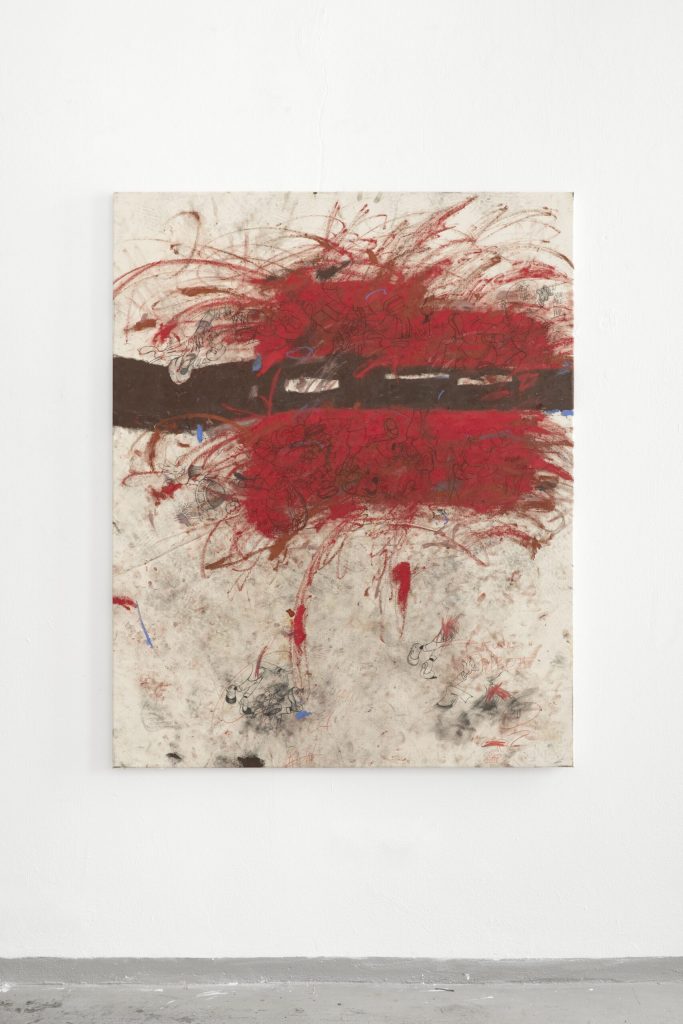
Honestly, I’m an extremely intuitive person, so I choose colors intuitively and I always tend to gravitate towards a certain palette that somehow keeps repeating in my work. I call my color palette basically “real colors.” They’re those kind of earthy colors that we normally see around us and that somehow don’t really trigger us.
But I basically never use green. I don’t know exactly why, but I have two weird reasons for it: green makes me sleepy, and I have this feeling that “real green” exists only in nature. I have an extremely ambivalent relationship with green. Of course I love nature, forests, our small garden, even camo clothes, which is pretty controversial these days, but because I use pre-made oil sticks and don’t mix my own colors, I just don’t trust these greens from the store.
Rather than consciously thinking about which colors to choose, my mood affects the work more through the level of expressiveness, or, on the contrary, through some kind of focused, concentrated drawing.
“What do you prefer: creating in the morning, in the afternoon, or at night?“
If I could choose, I would definitely choose the night. I’m definitely a night person, and definitely not a morning person, sometimes an afternoon person – and I have to make the most of that “sometimes” now, because I’ve been a mother for almost two and a half years and I usually have time in the afternoon, when I have childcare or when I keep my child entertained in the studio with me.
For several years before having a child, I lived in my studio for years, and I used to work whenever, quite commonly at night. Golden ages. Except that I was probably high on turpentine fumes and all sorts of other shit or that whole four or five years.
“Is there any work you have created while traveling?“
I live half in Athens and half in Prague, and I still don’t have a studio in Athens, which I definitely plan to change within the next few months. In our ridiculously small apartment in Athens, I sometimes draw. We live in Exarchia, which is quite an inspiring neighborhood, so it sometimes makes me want to create something. Definitely not during the summer though, because in those forty-degree temperatures, I’m more likely to melt along with my oil sticks.
“What do you like to do when you need a change of scenery during the process?“
Hm. I guess I would simply end my work for the day. If I stop enjoying the work in that particular moment, I leave the studio and just don’t come back that day. I simply interrupt the work, or I finish the painting by leaving it unfinished.
One great thing about my paintings is that they don’t have to be painted all the way to the edges of the canvas. I leave space for the raw canvas itself, which is a great advantage and works quite well with this feeling of just walking away from the work.
“What do you enjoy most about your day-to-day life as an emerging artist?“
Probably the possibilities.
“Is there any work you would like many people to see?“
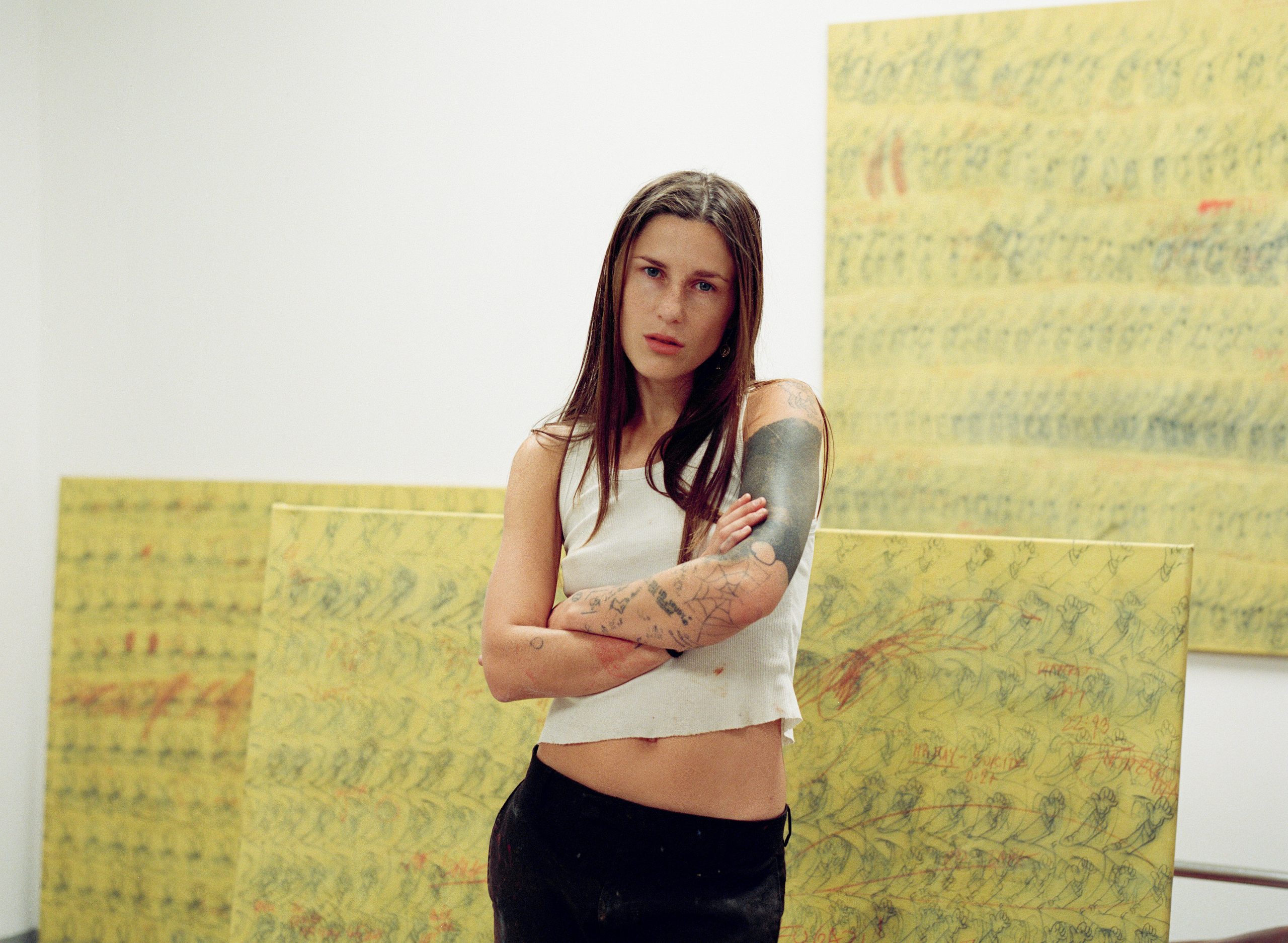
There is one work I’d really like many people to see. I worked on it for a long time, almost a year, which is a really really really long time for me. My paintings are usually very expressive, fast, and contain a capture certain mood of the situation. This work is called Snap Crack and it’s a triptych on this kind of boring ochre background, reminiscent of old storyboard papers. There’s only one recurring motif appearing over and over again throughout the paintings.
It’s basically just a record of a certain amount of time spent with the painting. A record of a tired hand and zero authenticity. I’m referring to my experience of working on a production line in a factory producing car parts when I was a teenager, and I’m transferring that mechanical, repetitive manual movement into a learned drawing of a motif that I basically stole, an already existing motif. This work completely changed the way I look at the subject of work. I don’t mean work. I mean WORK. LABOUR. GRIND.
“What do you find more valuable: originality or honesty in art?“
100% honestly. Sometimes it hurts.
“How do you organize your time between creating and the rest of your life?
I don’t know. Probably not at all. There is freedom in constraint, disorder in chaos, and confusion in structure. That’s basically how I live.
” What would you like to achieve in the coming years with your work?”
I think that eventually I’ll move towards film or literature, or maybe both. I love painting, but I often feel that it’s too flat for me, and that I personally exhaust its seemingly endless limits quite quickly. Lately, I’ve noticed that painting is actually the last thing that interests me in exhibitions and galleries.
Even though I’m doing better and better, I have a sold-out studio, exhibitions lined up, my work is in some pretty good collections, and everything looks great, I sometimes get this weird feeling from this commodity-based type of art: Is this really all I’m capable of? Funny side note: I once went to a numerologist. He told me that I would move the cards in the world, and I keep thinking that these definitely aren’t the cards I want to play with. But of course, I’m a realist, so back down to earth.
I’ve always loved film, music, literature, and actually sculpture more than painting – something more tangible, something with many more layers. So in a few years, you’ll probably find me somewhere over there rather than here. I don’t know, I can’t really say. But as I already said somewhere at the beginning, once my intuition pulls me somewhere else, I’m probably the last person who should have any reservations about taking a different path.
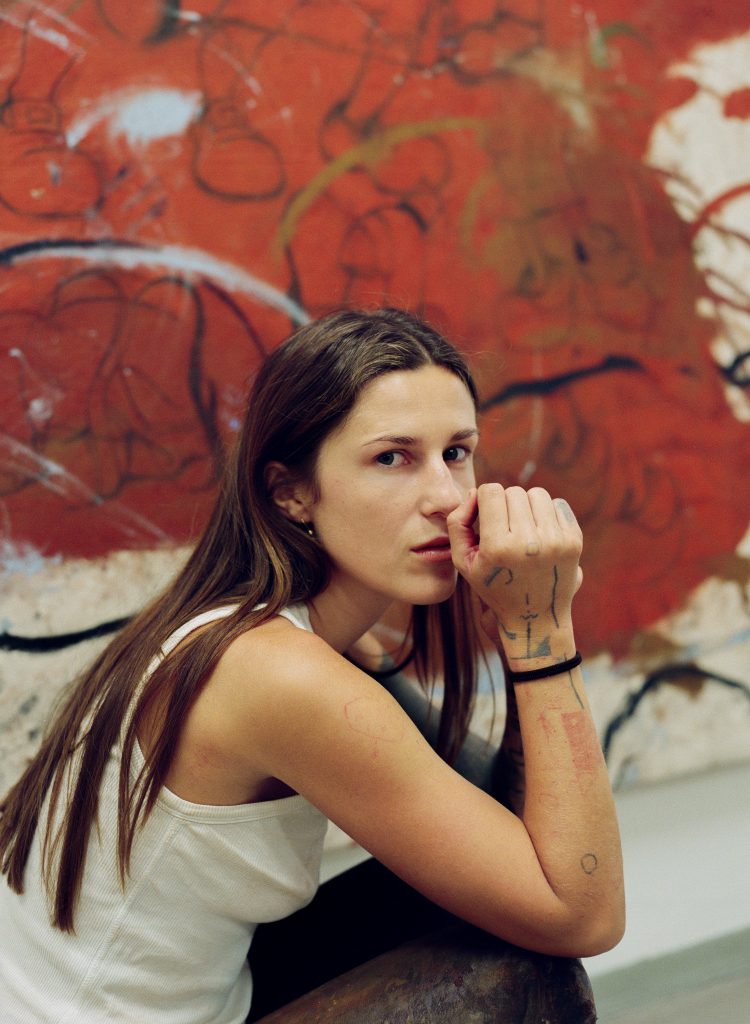
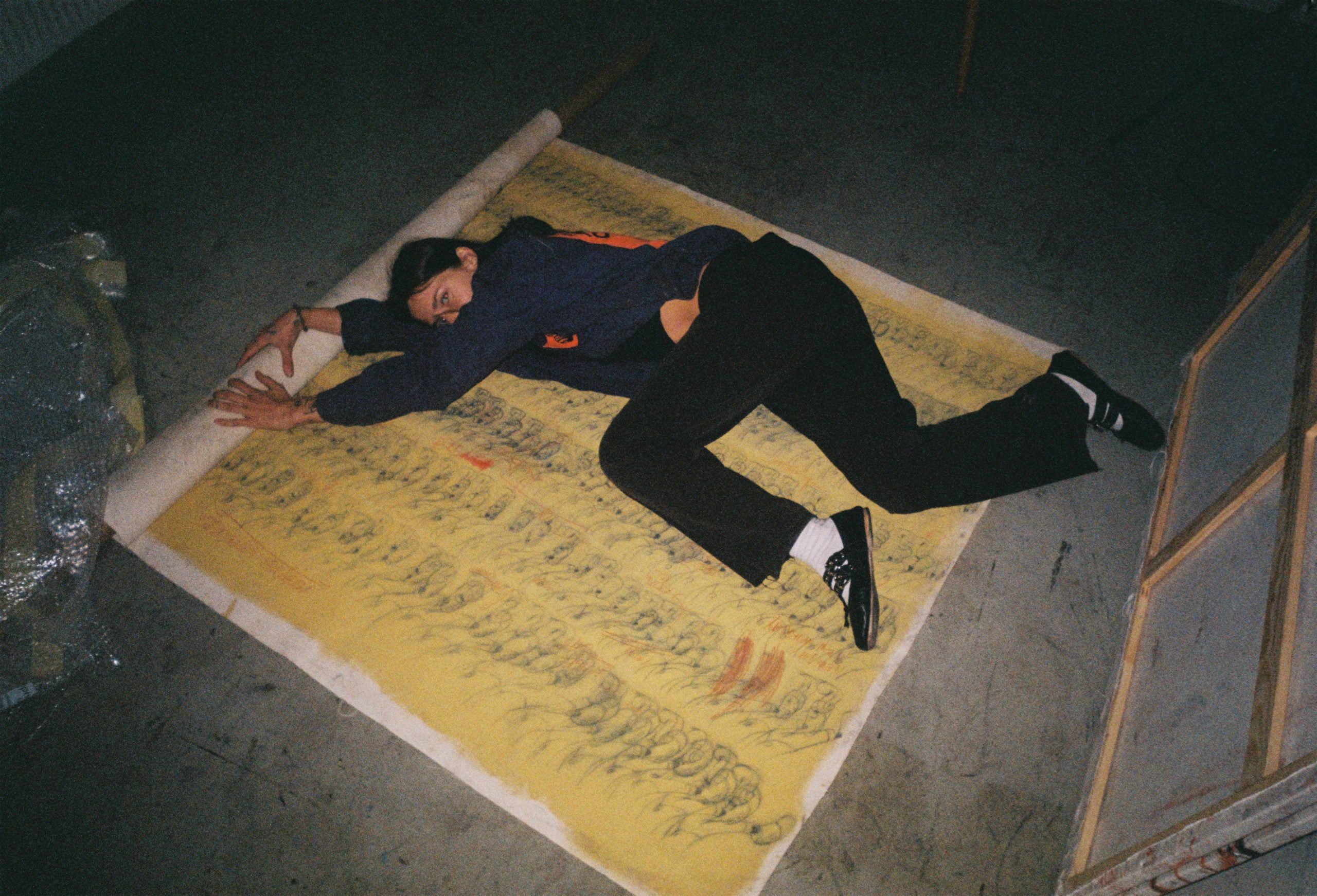
Ester Parasková (b. 1993, Brno) is a contemporary Czech painter currently working between Prague and Athens, whose artistic practice is defined by a dynamic tension between spontaneous expression and meticulous precision; she often works with her canvas on the floor, allowing traces of movement, footprints, and studio dirt to become an organic part of the piece, while her paintings combine bold, expressive color fields with the slow, focused labor of intricate drawing. Thematically, she explores repetition and mechanical processes, to shift focus from consumer aesthetics to the invisible labor behind them, viewing painting and drawing as a form of repetitive, time-based, and physically demanding work. A graduate of the Academy of Arts, Architecture and Design (UMPRUM) in Prague, she has held numerous solo and group exhibitions across Europe, Australia, and the United States, including notable shows like FUGAZI at Elektrohalle Rhomberg in Salzburg (2025) and SCRAP at NoD Gallery in Prague (2024), and her work has also been featured at art fairs such as VOLTA New York.
Piece with Artist Magazine. AUGUST 2026. © www.piecewithartist.com
@piecewithartist
@PARASKOVAESTER