PAINTER. GLASGOW, UNITED KINGDOM.
My name is Douglas Cantor, 31. Born in Puerto Boyaca, Colombia. Lives in Glasgow, UK. Married to painter Sophie Vallance, no children, two cats. “The less I worry the best.”
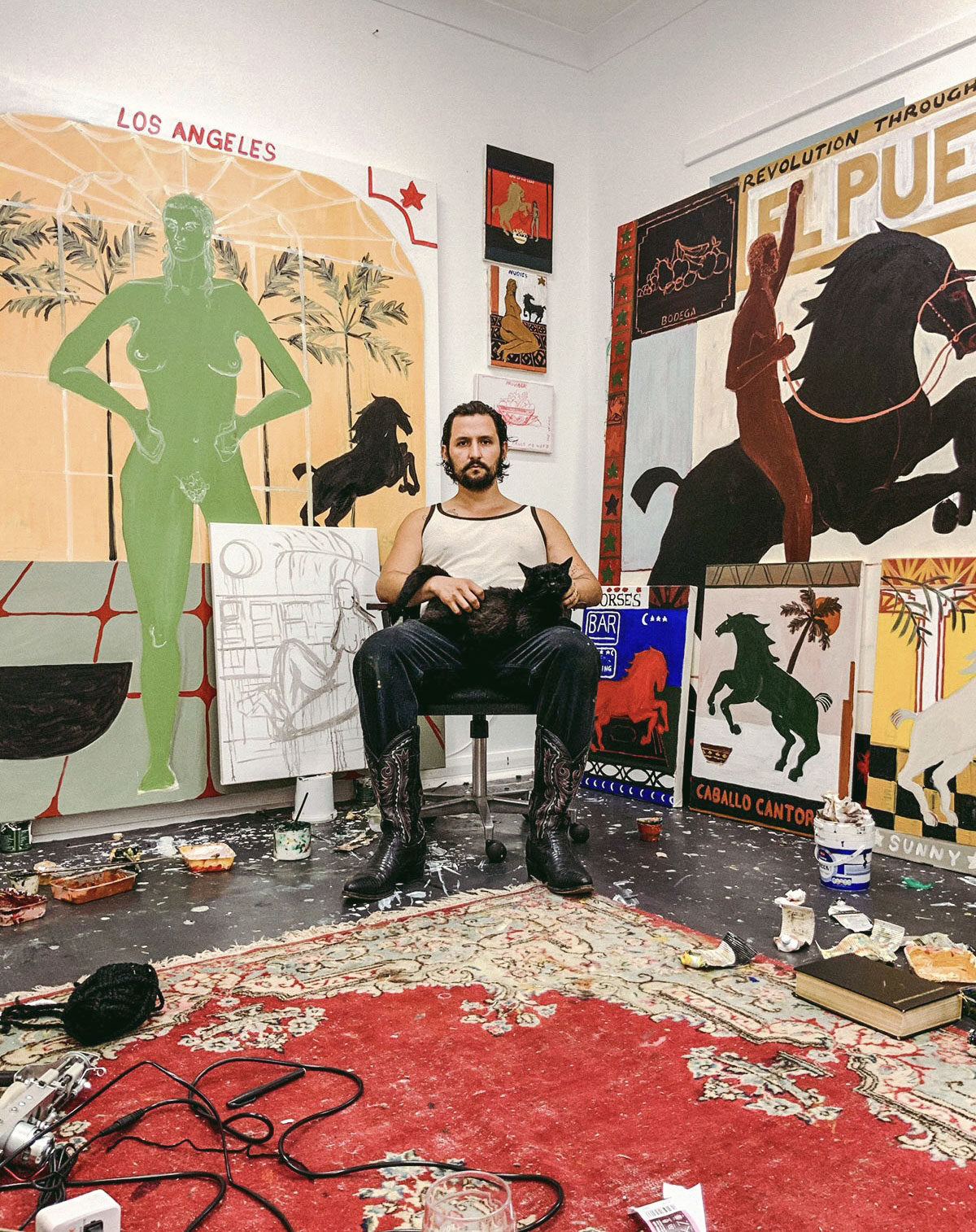
I came to painting by accident I think. I have always been of a creative leaning and tried all of the things to try, but painting was never an option in my mind. On one hand, I didn’t understand it, on the other hand, I came from a place, culture and social class that had no time for things that didn’t meet a clear purpose.
I made music as a teenager (it’s funny how music and art are seen as different things and consumed in such different ways, when I reality music is probably the best way to teach people how to approach art) and I did illustration, basically I thought that if I wanted to persue arts there had to be a communicational side to it, so I could justify it. A way to explain this, is thinking about what forms of art most people consume, films, comic books, design. Etc. So I nibbled all of those. I also had a fixation with skill- as in virtuosity and craftsmanship.
Again a result of my upbringing and this made me feel like painting was only the classical stuff and the stuff I didn’t understand. When I turned 19 and after having being kicked out of an art degree in Colombia I had an opportunity to come to the UK to learn English. Three months of a mandatory English course, one week of accommodation and a £1000 to my name. It was supposed to be an in-and-out, a privileged chance to get a leg up back home. Somehow I strung it along, got a job cleaning offices in Oxford street at 3am, and decided to apply to university, a way to stay longer, a chance to make things and prove myself. So for a year I ended up juggling three jobs, I was a bartender a cleaner and a care taker in a household that would give me a small room instead of payment.
And I worked on a portfolio to apply to Camberwell College of Art. And I got in. I got accepted onto illustration, thinking I would end up as a comic book artist or something like that but firstly, that ain’t the British school of art at all and second I came to realise I’m just not cut out to follow orders. It pained me to follow briefs. So i started focusing my time on “technique”. Here in the U.K. people get into these courses after A levels where they’ve already learned the basics, then at Uni they tell you to forget it all. I hadn’t learned it, so I did just that. Acrylic, gouache, watercolour, drawing – to no surprise I didn’t do well at Uni and never really got along with tutors. But all of this was for the best, I slowly got rid of what I didn’t like and it left me with what fascinated me, painting.
By the end of the first year I had stopped following the curriculum, I was just doing enough to pass and instead focused on painting or, a pedantic version of it at least, and then I met Sophie, my wife. She is a painter. An amazing one. And through her, seeing her make, it clicked in me that painting was worth it, and free and unapologetic, yes it was still self indulgent, but I don’t care. Putting paint on a canvas was the best thing I had ever done. It just made all the sense and then seeing myself a “painter” I felt it completed me.
I’m a very difficult to please person, always unsatisfied. A grass is greener kind of person some might say. But then there is painting and I have never had a doubt or have felt that there is anything else for me but painting.
Free, unpreoccupied, honest. It’s being a long process of shedding layers of worry, preoccupation, what ifs. I think it comes with rejection and age. I learned that the less I worry the better. When I paint it’s all about the painting. I no longer try to control it or even understand it. I just trust it. My practice is egotistical, I paint things I want to paint. Or that mean something to me. No theory, no anticipation of how is going to be dissected or how to justify it.

I came to realise I’m a visual person, I just see it in my head, the compositions and colours. I draw ideas, many at a time and then I tend to have multiple canvases going at once too. Then I just sit in front of them and think, a lot. I try to see past the ideas to let the paintings ask for what they need. That’s probably the motto I repeat to myself. “make it the best painting it can be, not the one you think it should be” “don’t make the painting you think it should be, make the best painting the painting can be.”
And no, no secrets. Everyone that knows me has heard what I have to say about painting; keep making. Every piece is a step, they all have their place, don’t worry about what they might say. Make the work for you and let yourself change and evolve. Your practice is the one thing that is yours!
A mix, literally. I have sketches around, and multiple canvases at once, some of them are improvised, some of them a mashup of many ideas. But maybe the right answer here is drawing. They start as lines.
I feel sad and lost in myself when I don’t paint. And when I don’t paint I feel like the reason I’m not painting is because I’m sad or unsatisfied with the work, or life.
Somehow I always forget that I am sad because I’m not painting. Because painting is the purpose I have. A painter is what I find myself in. So when I paint again I remember its not about the image in the canvas, or the meaning in the image. Is about re-discovering myself in the act of painting. Re finding my place as the painter.

There is no greater relief to my soul than remembering that I’m the painter and that that is all I ought to be. That’s who I want to be, the painter and all of what it entails.The ups and downs. The success and the rejection.
As for influences, my greatest one is Sophie, no doubt. She was my window to this world.
My studio is at home. Or maybe it would be best described the other way round. My home is at the studio. I rent a house in Glasgow that is 80 percent studio, the rest being storage bedroom and kitchen and bathroom. If it was completely up to me it would all be one space. The fact that this is how it is, has been a blessing during the pandemic.

Piece with Artist. © www.piecewithartist.com