march 3, 2026. words by Suso Barciela. Piece with artist magazine.
It’s curious to see that in the AI era, the art world seems to be going in the opposite direction. While screens bombard us with perfect images, generated in seconds, and business strategies disguised as entertainment, artists’ studios are once again filling up with sawdust, clay, and layers of oil paint that take months to dry. This isn’t just a simple bout of nostalgia or a rejection of technology, but rather a physical and necessary reaction to the loss of substance in what we consume visually.
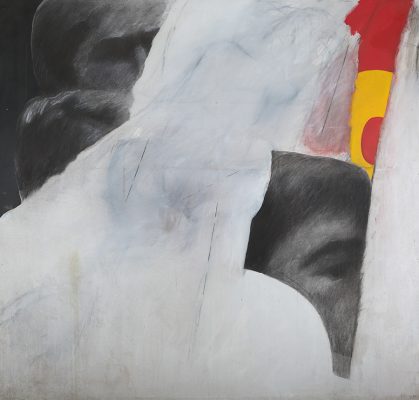
Today, the image has become a constant flow, a flicker of data that vanishes as soon as we swipe our thumb across the phone’s glass. We hold in our hand whatever we want, whenever we want it and that has given us a somewhat dangerous power of decision. Although I must admit that I am increasingly realizing that painting has decided to reclaim its gravity. And I’m not talking about its historical importance or the value assigned to it by the market, but about its actual weight. I’m talking about that almost stubborn will of painting to occupy a physical space, to smell of turpentine, and to impose its own timing, which has no understanding of the immediacy demanded of us out there.
We are slowly witnessing the funeral of perfection. Faced with the dictatorship of the algorithm, capable of delivering an impeccable yet poreless aesthetic, the contemporary eye has begun to seek out error. Today’s collector is no longer just looking for an image which, after all, is cheap and ubiquitous now but for the trace of the struggle. What attracts us now is the brushstroke that halts abruptly, the texture that casts a minimal shadow on the canvas, or the uneven seam of a piece of linen. We have turned imperfection and detail into the last frontier of the human, the only refuge that the machine cannot yet fully colonize. For now.
There is a phrase we often repeat when analyzing this: “The algorithm is a slave to statistics; the artist is the master of the accident.” It’s a fundamental distinction. Artificial intelligence can simulate texture astonishingly, it can project light and shadow with mathematical precision and replicate styles with unsettling fidelity, but there is one thing it cannot do: it cannot inhabit matter. Technology does not know the resistance of wood when working with or against the grain, nor does it understand how pigment decides to surrender or rebel depending on the humidity in the studio air that day.
The physical support has become proof of existence. In a world of ghostly copies and artificial representations, the tangible, material object is the only thing that can certify that someone was truly there. It is the testimony that a hand trembled, that a body sweated, and that there was a real pulse behind every aesthetic decision. The “hand of the artist” is no longer that romantic and somewhat outdated concept from a century ago; today it is an act of political and sensory resistance against transparency.
Piece with Artist MAGAZINE © march 2026
@piecewithartist